
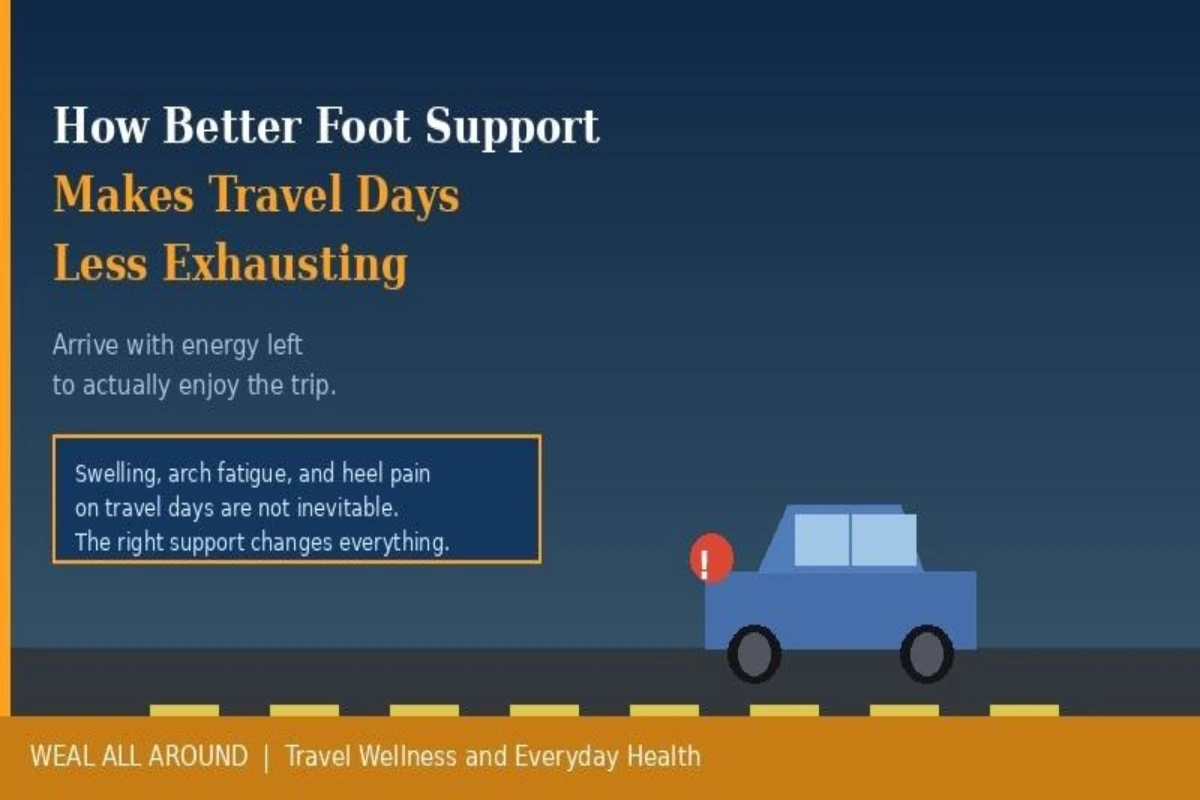
You spend weeks planning a trip. You sort the accommodation, map out the itinerary, pack everything perfectly. But by the second day, your feet are aching, your heels hurt on the stairs, and the shoes that felt fine at home are suddenly the enemy.
It happens to a lot of travellers, and most people chalk it up to just being on their feet more than usual. But the truth is, travel-related foot fatigue is not random. It is almost always the result of a few specific things that are easy to get ahead of if you know what to look for.
Here is what actually causes it, and what you can do before your next trip to make a real difference.
A little preparation before you leave can save you a lot of discomfort once you arrive.
Why Travel Days Are So Hard on Your Feet
Whether you are doing serious road trip planning or catching a long-haul flight, travel days put your feet through something genuinely unusual. You are sitting still for hours, which slows circulation in your lower legs and causes fluid to pool in your feet and ankles. Then the moment you arrive, you are suddenly walking much more than you would on a normal day at home.
That combination is rough. Feet that have been sitting in cramped conditions for hours are not in a great state to handle a full afternoon of sightseeing. The swelling that builds up during the journey makes your shoes feel tighter. Your arches, already tired from the lack of support during the travel portion, are now being asked to carry you around a new city.
The other factor is footwear. Most people wear whatever is convenient for the travel day itself, then change into their proper shoes once they get to the destination. But the travel day is actually when support matters most. Sitting in a plane or a car for hours with no arch support leaves your feet in a poor position for everything that comes after.
The right habits on travel day set your feet up for everything that follows.
What Good Foot Support Actually Does
Support is one of those words that gets used a lot without much explanation. Here is what it actually means in practice.
A shoe with good support holds your foot in a neutral, aligned position so the muscles in your arch are not constantly working to stabilise themselves. On a normal day, that matters. On a travel day where you are walking significantly more than usual across unfamiliar surfaces, it matters a lot more.
Cushioning and support are not the same thing. A shoe can be very soft and well-cushioned but still leave your arch doing all the work. What you want is structure: something that keeps the foot aligned through each step rather than letting it roll inward or outward with every stride.
For people who deal with recurring arch fatigue, heel pain, or foot soreness that flares every time they travel, custom orthotics can be a significant upgrade over any off-the-shelf insole. They are shaped to the specific way your foot loads, which means they are more effective than a generic insert across a full day of walking. The orthotic specialists at Beaver Valley Foot Clinic have a detailed breakdown of what a proper orthotic evaluation covers and which conditions tend to benefit most, which is worth reading if you have been managing with over-the-counter insoles and wondering why they are not quite doing the job.
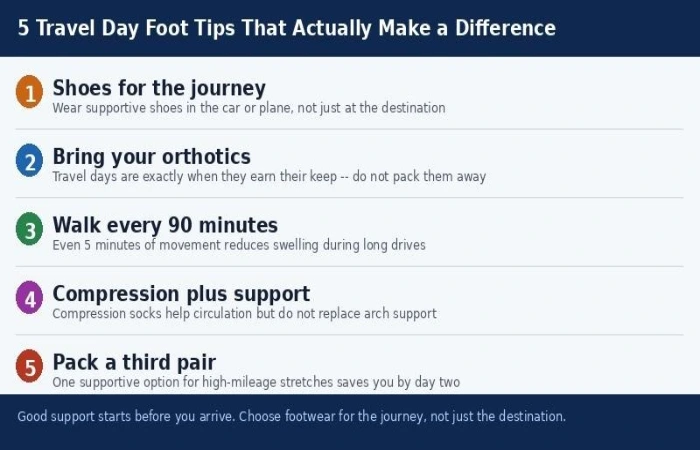
Beyond orthotics, the simplest thing you can do is wear your most supportive shoes on the travel day itself rather than saving them for the destination. It sounds obvious, but most people do the opposite.
Small Habits That Add Up
Footwear is the biggest lever, but a few other habits make a genuine difference on long travel days.
Get up and move every hour or so. On a long flight or drive, even five minutes of walking around does a lot to keep circulation moving in your lower legs. It directly reduces the swelling that builds up during extended sitting, which means your feet are in better shape when you actually need to use them.
Try compression socks for flights or long drives. They are genuinely useful for reducing lower-leg swelling during extended periods of sitting. They work best when you put them on before the journey rather than halfway through, once swelling has already started.
Pack a second supportive option. If your trip involves a lot of walking, bringing a backup pair of comfortable shoes is worth the luggage space. Shoes that feel fine on day one can feel very different by day three, especially if you are covering more ground than you expected.
If you are someone who likes to track activity levels while travelling, some of the newer health wearables are genuinely useful for this. Seeing your step count on a travel day is often surprising, and it can help you figure out when to build in rest days rather than pushing through until your feet force the issue.
When Foot Pain Is More Than Travel Fatigue
Most travel-related foot soreness clears up with a rest day and sensible footwear. But it is worth knowing the signs that suggest something more is going on.
Heel pain that is worst first thing in the morning, even after a rest day, is often a sign of plantar fasciitis rather than ordinary tiredness. Swelling that does not reduce overnight, pain concentrated in one specific spot rather than a general ache, or any numbness or tingling in the feet are all worth getting checked out rather than waiting to see if they settle on their own.
Travel periods are actually a common time for these issues to develop or flare up, simply because you are putting higher-than-usual demand on your feet while also sleeping in unfamiliar beds and wearing shoes for longer hours than normal. Getting it looked at sooner rather than later is nearly always the better call.
Set Your Feet Up Before You Leave
The best time to think about foot support is before the trip, not on day two when you are already limping around a new city. The choices that matter, what you wear on the travel day itself, whether your orthotics are in your bag, whether you take a few minutes to walk around on the plane, are all decisions you can make in advance.
None of this requires a big change to how you travel. It just requires giving your feet a bit more thought in the planning stage. Do that, and you are far more likely to arrive somewhere new with enough energy left to actually enjoy it.