
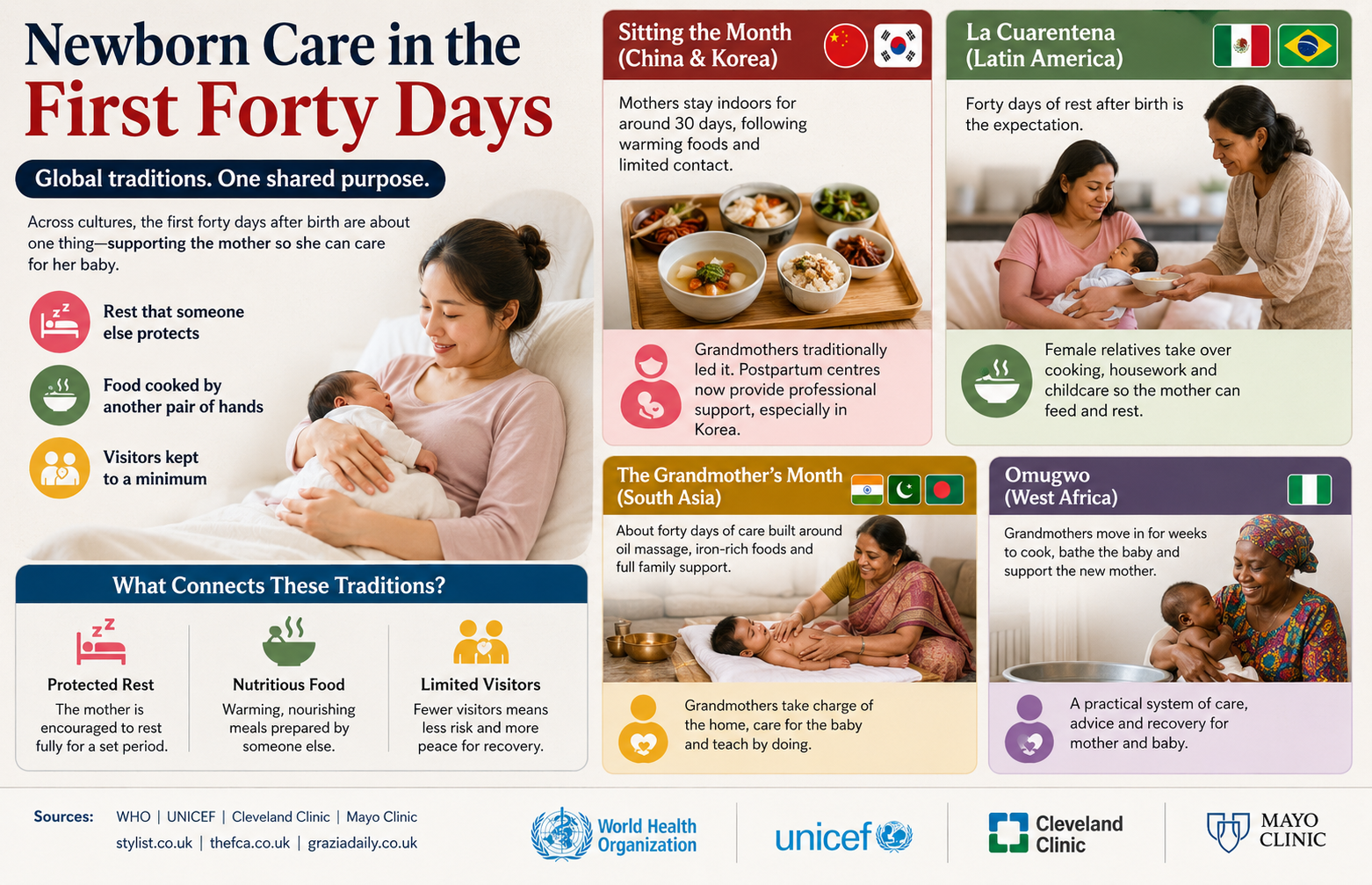
Newborn care in the first forty days looks very different depending on where a family lives. In some countries the mother stays indoors for weeks, eats a set list of warming foods and hands the night care to a relative who has moved in. In others she is back at the supermarket within a fortnight. The gap has less to do with beliefs about babies than with who is available to help.
Forty days keeps turning up as the marker in cultures that share very little else, which makes it worth looking at what those traditions ask of a household. Most rest on the same idea, that the mother is looked after so she can look after the baby, and most assume family help that fewer parents now have nearby.
Why forty days keeps recurring
Six weeks is roughly how long the uterus takes to return to its pre-pregnancy size, and traditions that settle on forty days tend to finish around the point where feeding is established and infection risk has dropped. Plenty of UK households have nothing resembling that structure, and the absence of the communal approach to early parenting found elsewhere leaves new parents working through those weeks with a partner and perhaps one friend.
What has replaced the extended family
Relatives who once turned up for a month now often live hours away, so the work has been divided between services instead. Midwives cover the first ten days or so, health visitors take on feeding, weight and maternal mood, and the structured early care attached to fostering babies in the UK runs to written plans and scheduled reviews rather than to whoever is free that afternoon. Formal support is more consistent and far better recorded, but it arrives in appointments rather than in someone sitting in the kitchen for three weeks.
Sitting the month in China and Korea
Zuo yuezi, usually translated as sitting the month, keeps the mother indoors for around thirty days on warming foods, with cold drinks, hair washing and visitors restricted. Grandmothers traditionally ran it, though paid confinement nannies are now common in Hong Kong, Singapore and Malaysia. South Korea built an industry on the same principle, and most new mothers there spend a fortnight in a postpartum centre where nurses take the baby overnight.
La cuarentena across Latin America
Forty days of rest is the expectation across Mexico, Central America and much of South America, and the name comes from cuarenta. Female relatives take over cooking, older children and housework so the mother can feed and sleep. Warmth is treated much as it is in Chinese practice, so cold food and washing are often limited, and families abroad tend to keep the food rules while dropping the rest.
The grandmother’s month in South Asia and West Africa
Confinement across India, Pakistan and Bangladesh usually runs to about forty days, built around daily oil massage for mother and baby, iron-heavy food and a grandmother who takes charge of the house. Omugwo in parts of West Africa works the same way, with the grandmother moving in to cook, bathe the baby and teach by doing. That is hard to reproduce across two countries, and early motherhood has become far more isolating in the UK for much the same reason.
What runs through all of them
The traditions differ enormously in the detail, and much of what they prescribe belongs to a particular place and belief system. Set against each other, though, they overlap on three points, and those are the parts that transfer anywhere without asking anyone to believe anything.
Rest that someone else protects: the mother stays off her feet for a fixed period rather than a negotiated one, which removes the need for her to keep asking.
Food cooked by another pair of hands: broths, soups and iron-rich dishes are made specifically for her, and the cooking is the first thing lost when relatives live far away.
Visitors kept to a minimum: Korean and Vietnamese families in particular limit who sees the baby early on, and the reasoning sits closer to infection control and undisturbed sleep than to superstition.
Very few UK families can clear forty days, but the underlying arrangement is easier to copy than it looks. Someone else doing the cooking, a fixed stretch where the mother isn’t hosting anyone, and one person who turns up regularly will cover most of what these traditions were built to do.