
The first time most people used an AI image generator, the experience was somewhere between impressive and uncanny. Type a sentence, wait a few seconds, and receive an image that — sometimes — looked like exactly what you described. Other times, it looked like a surrealist approximation of the prompt, with fingers going in unusual directions and text that dissolved into decorative squiggling.
That period is largely behind us. The tools available in 2026 have improved in ways that matter practically: better prompt understanding, more reliable anatomical accuracy, more consistent style application across multiple generations, and meaningfully faster processing. For creators who dismissed the technology a year or two ago based on early experiences, the current state of the art warrants a fresh look.
What Is Actually Happening When You Type a Prompt
Understanding what happens inside a text-to-image system makes it easier to work with these tools effectively, because it explains both why they perform well under certain conditions and why they fail under others.
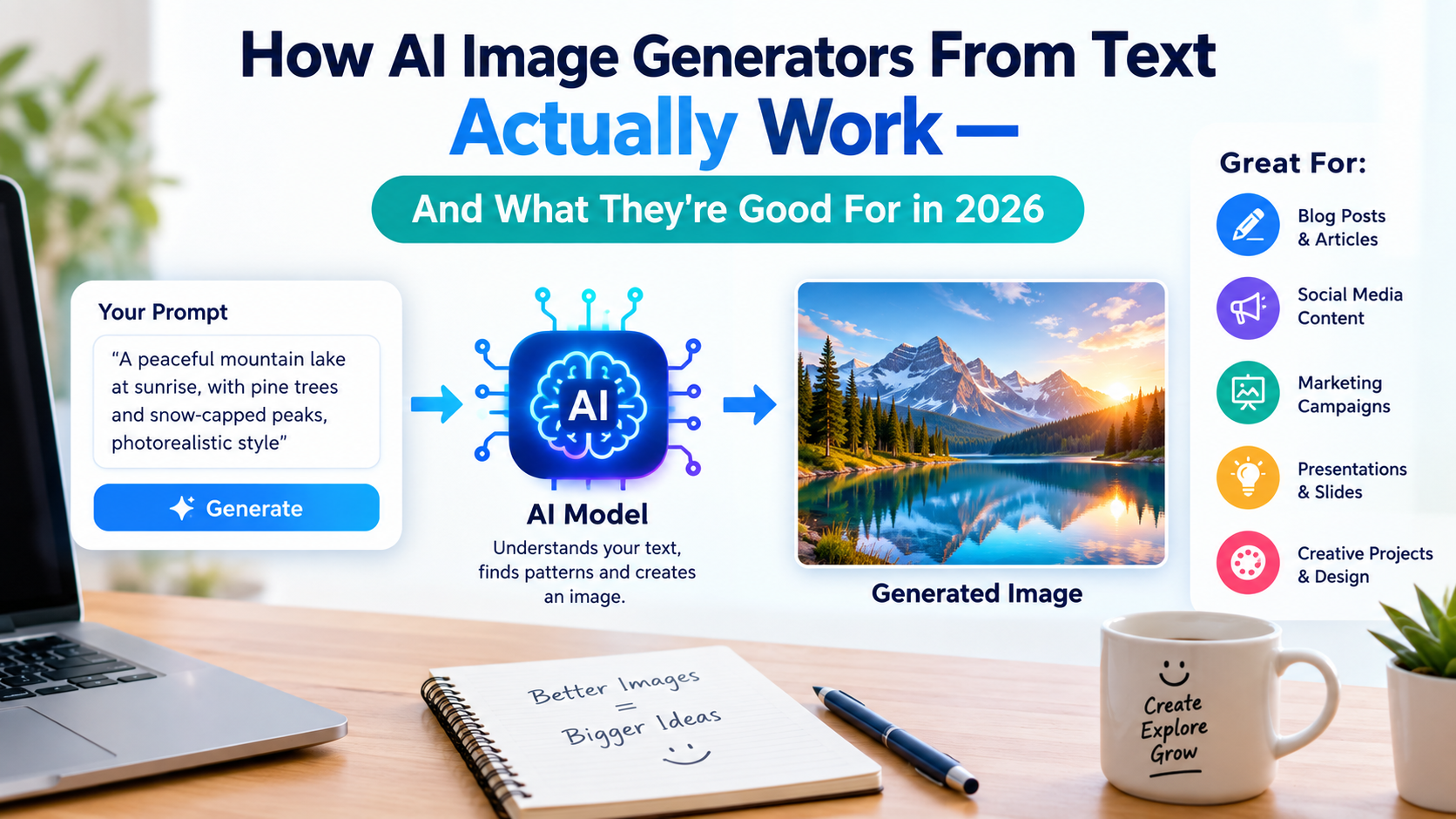
Modern text-to-image generators are built primarily on diffusion models — a class of neural network trained to reverse a specific process. During training, the model learns from large datasets of image-text pairs: millions of images with associated descriptions, captions, or metadata. The training process gradually adds noise to images until they become pure static, and teaches the model to reverse that process — to remove noise in a way that produces a coherent image.
When you type a prompt, the system uses a language model to convert your text into a numerical representation — a set of embeddings that capture the meaning and relationships within your description. The image generator then uses those embeddings to guide the denoising process, producing an image that corresponds to the encoded meaning rather than to the literal words.
This explains several things that are not immediately obvious. First, why slight rephrasing of a prompt can produce dramatically different outputs — because the language model encodes meaning rather than words, and different phrasings carry different semantic weight. Second, why abstract or conceptual prompts often produce more interesting results than hyper-literal ones — the model has seen many representations of abstract concepts and can draw on that variety. Third, why specific technical details — exact measurements, precise colour codes, specific counts of discrete objects — remain unreliable in generated outputs, because the model learned from descriptions that rarely conveyed that level of precision.
What Text-to-Image Generators Are Actually Good At
The capabilities of these tools have developed unevenly, and understanding where they consistently deliver helps set appropriate expectations.
Atmospheric and environmental imagery. Landscapes, interiors, abstract scenes, lighting conditions, and mood-driven visuals are areas where current generators perform reliably well. The training datasets for these categories are rich, the visual vocabulary is broad, and the outputs tend to feel coherent even when they are not perfectly precise.
Style application and consistency. Generators have learned from enormous ranges of artistic styles — photographic, painterly, illustrative, architectural, editorial — and can apply these styles consistently across a generation session. A creator who wants ten product mockup images in a consistent cinematic style can achieve that without the output drifting between different aesthetic registers.
Concept visualisation before production. One of the highest-value applications of AI image generation for working professionals is the ability to visualise concepts quickly before committing to production resources. A marketing team exploring directions for a campaign, a product designer testing colour options, a social media manager generating thumbnail concepts — all of these benefit from fast, low-cost visualisation that does not require a designer to produce at this stage.
Variation generation at scale. For creators who need multiple visual options across a single concept — different compositions, different colour treatments, different background environments — AI generators can produce that variety far faster than any manual process.
Where Current Generators Still Struggle
Being honest about limitations is as important as understanding capabilities.
Text within images remains an area of inconsistent performance. Logos with specific lettering, signs with readable content, typographic elements — these require careful prompting and post-processing review to get reliable results. The fundamental architecture of diffusion models was not designed with glyph-level precision in mind.
Specific real people and recognisable IP are areas where responsible generators have implemented restrictions, and where the outputs of systems without those restrictions carry significant legal and ethical risk. AI-generated images that closely resemble specific individuals or reproduce protected intellectual property create liability that most professional users should not accept.
Complex spatial relationships and perspective. When a prompt describes a scene with precise spatial logic — “three objects arranged in a specific geometric pattern with a fourth behind them at this angle” — the outputs tend to approximate rather than accurately represent the described arrangement. This is improving with newer architectures but has not been fully resolved.
Hands and extremities. This has improved substantially from the six-fingered horrors of early models, but close inspection of hands in generated images still warrants review before publication, particularly in contexts where this would be immediately noticed.
Writing Prompts That Get Useful Results
The skill of prompt writing has developed into something genuinely learnable, and the difference between a useful output and a frustrating one often comes down to a few structural principles.
Lead with the subject, then the context, then the style. A prompt structured as “subject — environment or scene context — visual style or mood” tends to perform better than one that buries the main subject halfway through a long descriptive paragraph. The model weights the beginning of a prompt more heavily in most implementations.
Be specific about style through reference to established visual registers, not just adjectives. “Cinematic” is interpreted differently than “cinematic in the style of low-contrast, desaturated colour grading with anamorphic lens characteristics.” The more specific the style reference, the more consistent the output tends to be.
Use negative prompting where the tool supports it. Specifying what you do not want — blurry, low quality, extra limbs, watermarks, text — reduces the likelihood of those elements appearing even when you have not described them positively.
Generate multiple outputs from the same prompt. Even high-quality prompts produce variable results because of the stochastic nature of the generation process. Generating four to eight variations from a single prompt and selecting the strongest one produces better outcomes than treating the first output as the final result.
An AI image generator from text that integrates prompt-to-image generation with further editing tools allows creators to refine outputs after generation rather than treating the generated image as fixed — which addresses many of the limitations described above by adding a post-generation editing layer that can correct specific issues without requiring a full regeneration.
The Workflow Integration Question
The most common mistake creators make when evaluating AI image generators is treating them as standalone tools rather than as components of a larger workflow. The practical question is not whether a generator can produce a perfect final image from a single prompt — for most professional applications, it cannot. The question is where in your existing workflow an AI generation step adds value.
For content teams producing high volumes of social media assets, AI generation can replace the stock image search and selection process, producing custom imagery that is not available elsewhere rather than generic licensed content. For product teams needing visualisation of concepts that do not yet exist physically, generation provides a low-cost alternative to photography of early prototypes. For individual creators building personal brand content, generation provides visual variety that would otherwise require stock subscriptions or commissioned photography.
In each of these cases, the value comes from the combination of AI generation with human review, selection, and editorial judgment — not from treating generated output as finished work.
The Copyright and Ownership Question
This remains an active area of legal development that creators using AI-generated images for commercial purposes should track.
The training data question — whether models trained on copyrighted images without explicit licensing create liability for their outputs — has been addressed differently in different jurisdictions and continues to develop through litigation and legislation. The output ownership question — who owns the copyright in an AI-generated image — has been partially addressed in several jurisdictions, with the general direction being that copyright protection requires human authorship and that purely machine-generated content may not receive the same protection as human-authored work.
For creators using AI-generated images in commercial contexts, reviewing the terms of service of the specific tool they are using (which typically grant usage rights to the creator while retaining certain rights for the platform) and monitoring legal developments in their relevant jurisdiction are both worthwhile ongoing practices.
Frequently Asked Questions
Q: How long does it take to generate an AI image from text?
Most contemporary text-to-image generators produce results within five to thirty seconds, depending on resolution, the complexity of the prompt, and current server load. High-resolution outputs or platforms experiencing high demand may take longer.
Q: Can AI-generated images be used commercially?
This depends on the specific platform’s terms of service. Many platforms explicitly grant commercial usage rights to paid subscribers or to all users. Free-tier usage may be restricted to personal, non-commercial purposes. Always check the terms of the specific tool before using generated images in a commercial context.
Q: Do I need design skills to use an AI image generator effectively?
Not in the traditional sense. The skill that transfers most directly from design to AI generation is the ability to articulate visual concepts precisely — understanding composition, colour relationships, and style conventions well enough to describe them in words. Design background is helpful but not required. The skill of prompt writing is learnable independently.
Q: Can AI image generators produce images in a consistent visual style across multiple outputs?
Yes, with appropriate prompting. Specifying consistent style parameters — using the same style description, colour grading references, and lighting conditions across prompts — produces outputs that hold together well as a visual set. Some platforms also support style-reference image inputs that further improve consistency.
Q: What resolution do AI-generated images typically produce?
Output resolution varies by platform and subscription tier. Many platforms produce images at 1024×1024 pixels as a default, with higher resolutions — 1536×1536 or larger — available at premium tiers or through separate upscaling tools. For most digital use cases, standard output resolution is adequate. Print applications may require upscaling.
The Bottom Line
AI image generation from text has moved from a novelty into a practical creative tool — not because it replaces human creative judgment, but because it compresses the distance between a visual idea and a visual representation of that idea.
The creators who get the most value from these tools are the ones who understand where the technology performs reliably, where it still requires human correction, and how to integrate generation into a workflow that produces better outcomes than either AI-only or human-only approaches would achieve independently.
The prompting skill, the workflow integration, and the editorial judgment about what to use and what to discard — these remain human contributions. What changes is how much of the mechanical production work can be delegated to an AI system that is, in 2026, genuinely capable of carrying it.