
A history teacher describing the signing of a landmark treaty, or a documentary creator explaining a pivotal battle, is always working against the same limitation — there’s no footage, because the event happened before cameras existed, or before anyone thought to point one at that specific moment. History has always relied on paintings, written accounts, and imagination to fill that gap.
Pippit’s Seedance 2.5 model gives educators, documentary creators, and history-focused storytellers a new way to visualize those moments, turning a written account into a cinematic recreation without a full historical production budget.
Why history has always struggled with a visual gap
Textbooks and museum placards do a reasonable job describing what happened, but description and visualization are different experiences. A student reading about a historic voyage or a political turning point often struggles to actually picture the scene — the clothing, the setting, the atmosphere of the moment.
Documentary producers have traditionally filled this gap with expensive dramatic reenactments, historical consultants, and costume departments, resources far beyond what most educators or independent creators have access to.
The recurring challenge for history-focused creators
-
Most pre-modern historical events have no photographic or video record at all.
-
Paintings and illustrations offer only a single frozen interpretation of a moment.
-
Traditional reenactment filming requires costumes, sets, and actors most educational budgets can’t support.
-
Getting details like period-accurate clothing and setting right requires real historical research, not just guesswork.
From historical account to shareable poster
A full recreation isn’t always necessary — sometimes a single striking historical-style image is exactly what a lesson plan or documentary promotion needs. Here’s how to create one using Pippit’s Seedream model.
Step 1: Generate your historical scene
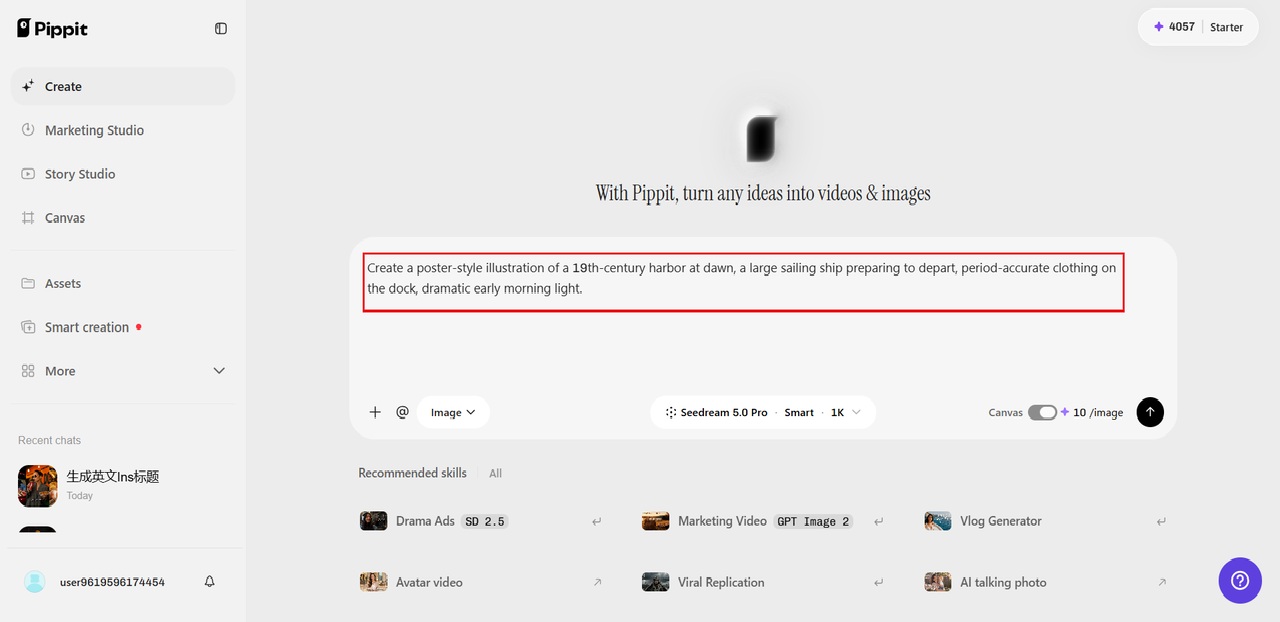
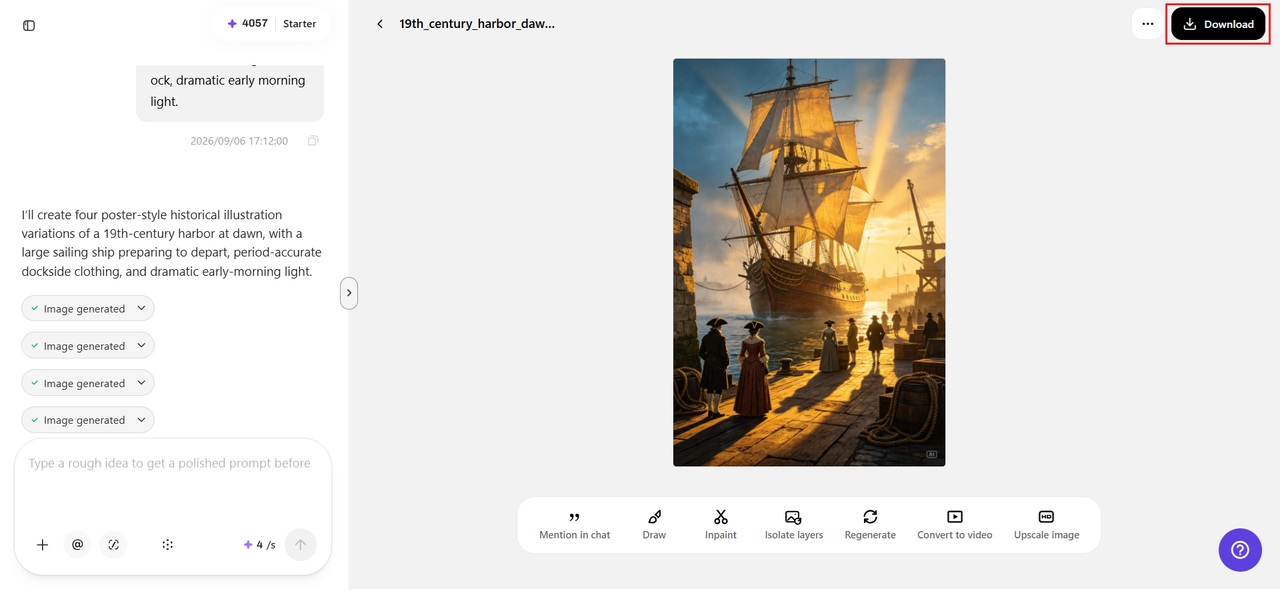
Open Pippit and select the Seedream model, then describe the moment with as much historical detail as possible.
For example: Create a poster-style illustration of a 19th-century harbor at dawn, a large sailing ship preparing to depart, period-accurate clothing on the dock, dramatic early morning light.
Add historical reference images to keep details accurate.
Step 2: Verify historical accuracy
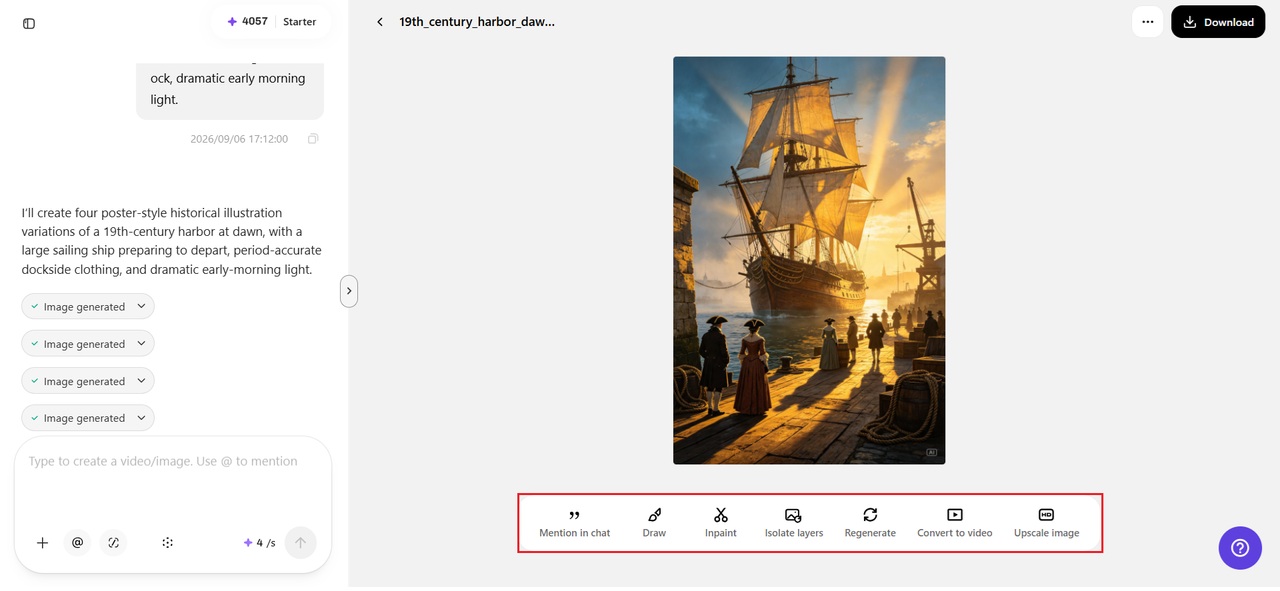
Review the draft carefully against your actual research — do the clothing, setting, and details match the real historical period, or does anything need correcting? Historical accuracy should always take priority over visual drama.
Step 3: Add context and export
Layer on the event name, date, or a short factual caption directly onto the image, then export at the resolution needed for a classroom presentation, a documentary trailer, or an educational social post.
Seedance 2.5’s approach to recreating the past
Full scenes instead of a single frozen illustration
With single-clip length extended from 15 to 30 seconds and up to two rounds of extension, a creator can show an actual sequence — a crowd gathering, a key figure speaking, the moment of a decision — rather than a single static illustration standing in for an entire event.
Time-stamped prompts for narrative sequencing
Time-marking lets you script exactly how a historical moment unfolds: the setting established first, the pivotal action in the middle, the aftermath or reaction at the close. This mirrors how a documentary narrates a scene, giving structure to what would otherwise be a single vague depiction.
Creativity transfer for period-accurate tone
The model’s creativity transfer capability can replicate the visual style and mood of a specific era or reference image, rather than just copying motion, helping a scene feel authentically period-appropriate instead of defaulting to a modern aesthetic.
Multimodal fusion for research-backed accuracy
Uploading historical paintings, photographs of artifacts, or period clothing references — up to 50 pieces of material per generation — helps ground a generated scene in actual historical research rather than generic guesswork about how an era looked.
Multilingual support for global educational use
With support spanning many languages, educators and creators can produce historical content directly for their own classroom or audience language, widening access to visual history content beyond English-first production.
Reduced “AI look” for documentary-grade credibility
Improved texture realism and cross-cut consistency help generated historical scenes feel serious and credible rather than like a stylized cartoon, which matters for maintaining the tone appropriate to educational and documentary content.
Narrating history with SeedAudio 1.5
A recreated historical moment lands with more weight when it’s paired with narration, and SeedAudio 1.5 can generate that documentary-style voiceover directly — providing dates, context, and factual grounding alongside the visual recreation.
This matters especially for educational use, where a clear narrated explanation helps students distinguish between a visual interpretation and the documented historical facts it’s based on.
Making historical content that actually teaches
Always pair generated visuals with clear factual context, since a recreation should support understanding, not stand alone as unexplained content. Use real historical references as generation inputs whenever possible, rather than relying purely on a text description.
Focus on well-documented events first, where enough historical detail exists to keep the recreation grounded and accurate. Build this into an ongoing AI video generator for a full curriculum or documentary series, since new events can be visualized steadily as a course or project progresses.
Handling historical sensitivity responsibly
Not every historical event should be recreated the same way — moments involving tragedy, violence, or trauma deserve a respectful, restrained visual treatment rather than dramatization for shock value.
Creators should also be transparent that a scene is a visual recreation based on historical research, not an actual historical record, so audiences understand the distinction between documented fact and an illustrative interpretation.
Bring history off the page
Some of the most important moments in history exist only as text and imagination, waiting for someone to help an audience actually see them.
With Seedance 2.5 inside Pippit, educators and documentary creators can recreate iconic past events with real visual impact, without the production budget a traditional historical reenactment would require.
If there’s a moment in history worth bringing to life, it’s worth opening Pippit and letting your audience finally see it.