
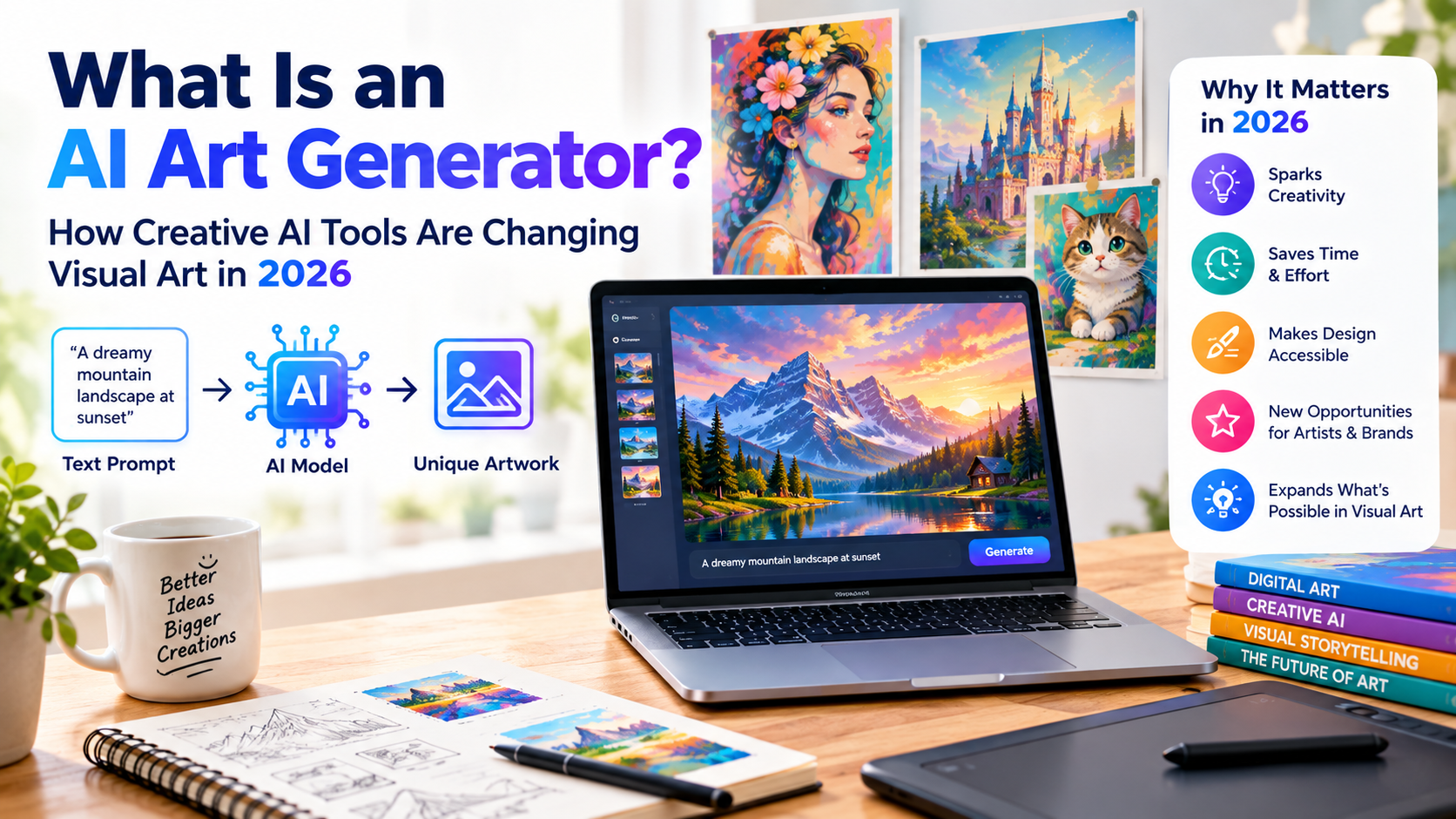
Something fundamental has shifted in how visual art gets made.
For most of recorded history, creating a visual artwork required either manual skill — the ability to draw, paint, sculpt or photograph — or the resources to hire someone who had it. The distance between a creative idea and a finished visual representation of that idea was measured in hours, days or months of skilled work. For most people, that distance was simply insurmountable. They had ideas for images they would never see realised.
AI art generators have changed this calculus. Not by eliminating the role of human creativity — that role remains significant — but by relocating where in the creative process human skill is most needed. The craft of directing a visual outcome, of knowing what you want and being able to describe and refine it, has become more central. The manual execution of that vision has become less so.
Understanding what an AI art generator actually does, where the technology performs well and where it still falls short, and how to use these tools effectively is increasingly useful knowledge for any creator working with visual content.
How AI Art Generation Works
The technical foundation of most contemporary AI art generators is a class of model called a diffusion model. Understanding the basic mechanism helps explain both the capabilities and the limitations of these tools.
During training, the model learns from an enormous dataset of images — photographs, illustrations, paintings, digital art, design work — typically paired with text descriptions or metadata. The training process involves repeatedly adding noise to images until they become unrecognisable static, and then teaching the model to reverse that process: to start from noise and reconstruct a coherent image.
When you type a prompt, the system uses a language model to convert your words into a numerical representation of meaning — a set of vectors that encode the concepts, relationships and qualities in your description. The image generation process then uses those vectors to guide the reconstruction from noise toward an image that matches the encoded meaning.
The practical implication of this architecture is that the model does not look anything up or assemble images from components. It generates each output fresh, guided by the statistical relationships it learned during training between visual content and textual description. This is why the same prompt produces different results each time, and why outputs that look similar to trained styles are not copies of those styles but new images that share their characteristics.
More recent architectures — including transformer-based and flow matching models — have extended these foundations in ways that improve consistency, controllability and output quality. The general principle remains: text guides generation, and the model’s ability to honour that guidance depends on the quality of its training and the design of its attention mechanisms.
The Range of Styles AI Art Generators Can Produce
One of the genuinely impressive capabilities of current AI art tools is their range. The visual styles these systems can apply span an enormous breadth — from photographic realism to watercolour painting, from architectural rendering to manga illustration, from oil painting textures to geometric digital abstraction.
This range reflects the diversity of the training data. A model that has learned from millions of images across every major visual tradition can blend and apply those traditions in response to prompts, producing outputs that sit at intersections of style that would be technically demanding for human artists to achieve and stylistically unusual for stock image libraries to contain.
For creators, this means that AI art generation is not limited to a single aesthetic register. The same tool that produces a photorealistic landscape can produce a folk art illustration of the same scene, a technical architectural diagram, a children’s book illustration, or an abstract expressionist interpretation. The navigation of that range is done through prompting, which makes the skill of describing visual outcomes precisely a genuinely valuable one.
Some areas of particular strength in current tools include atmospheric landscape and environmental imagery, fashion and character design in illustrative styles, product visualisation in photographic contexts, typographic art and poster-style composition, and abstract and generative art where precision of form is less critical than visual interest.
Writing Prompts That Produce Useful Results
The prompt is the primary interface between human creative intent and AI output, and the difference between a prompt that produces something useful and one that produces something frustrating is often structural rather than a matter of vocabulary.
A few principles that hold across most current tools:
Lead with the primary subject before descriptive detail. The model weights the beginning of a prompt more heavily in most implementations. Describing what the image is of before describing how it looks produces more reliable results than burying the subject in adjectives.
Reference visual styles through conventions rather than just adjectives. “A portrait in the style of baroque oil painting, with dramatic chiaroscuro lighting and rich jewel-toned colour” gives the model more to work with than “a beautiful portrait with nice lighting.” Style references that invoke established visual traditions — movements, techniques, mediums — produce more consistent outputs than abstract quality descriptors.
Specify what you do not want, where the tool supports negative prompting. Naming elements to exclude — blurry, overexposed, crowded composition, text, watermark — reduces the likelihood of those elements appearing even when you have not mentioned them positively in your prompt.
Generate multiple variations before selecting. The stochastic nature of diffusion generation means that the same prompt produces different results each time. Generating four to eight variations from a single prompt and selecting the strongest one consistently produces better outcomes than treating the first output as definitive.
Iterate rather than restart. When an output is mostly right but wrong in specific ways, revising the prompt to address those specific issues and regenerating is more efficient than starting over with a completely different approach. Treat each generation as information about how the model is interpreting your prompt.
Where Human Creativity Still Leads
The temptation when discussing AI art generators is to frame them as either a revolutionary replacement for human creative work or a superficial party trick. Neither characterisation is accurate, and understanding where human judgment remains essential helps set realistic expectations.
Conceptual originality is not something that emerges from AI generation without human direction. The model generates outputs that reflect patterns in its training data. Novel creative concepts — ideas that are genuinely new in their construction or meaning — still originate with human creators. The AI can execute and explore a concept; it does not originate one independently.
Cultural context and meaning-making require human understanding. An image can be technically well-executed and visually interesting while being entirely wrong for its intended audience, inappropriate for its intended context, or tone-deaf to the cultural associations it carries. These judgments require the kind of contextual human understanding that AI systems do not currently have.
Editorial selection and sequencing remain human responsibilities. In a workflow where an AI generates ten variations of a concept and a human selects the best one, the editorial judgment that makes the selection is providing real value. The ability to identify which output best serves the intended purpose requires understanding that purpose in full context.
Post-generation refinement and integration. Most professional applications of AI-generated art involve some level of post-processing — colour correction, compositing, combination with other elements, correction of specific artefacts. The skill to do this well, and the judgment about when it is needed, remains with human creators.
Practical Applications Across Creative Contexts
The range of contexts where AI art generation is being used in professional creative work has expanded considerably in the past two years.
Marketing and brand content teams use AI art generators to produce custom imagery for social media, editorial, and campaign content at volumes that would previously have required either large photography budgets or heavy reliance on stock libraries. The ability to produce on-brand custom imagery rather than licensed generic content is a meaningful practical advantage.
Game and entertainment concept development has adopted AI generation as a tool for rapid visualisation of environment, character, and prop concepts at early development stages. Generating fifty concept variants in a session would previously have required a week of illustrator time; AI generation compresses that to hours, allowing teams to explore more creative territory before committing resources to development.
Independent creators and content publishers use AI art for thumbnail creation, article illustration, social media assets, and personal creative projects. The combination of accessibility and capability means that creators who previously worked entirely in text or audio now have viable options for visual content without requiring design skills or budget.
Interior design and architecture visualisation has adopted AI rendering tools for client-facing concept presentations, producing photorealistic visualisations of spaces at a fraction of the cost of traditional rendering pipelines.
Responsible Use and Current Limitations
A full picture of AI art generation includes its limitations and the responsible practices around its use.
Training data and copyright remain active areas of legal and ethical discussion. The question of whether models trained on copyrighted images without explicit licensing create liability for their outputs is being resolved differently across jurisdictions through ongoing litigation and legislation. Creators using AI-generated art commercially should monitor developments relevant to their jurisdiction.
Representation and bias in generated outputs reflect patterns in training data, which is not a neutral or representative sample of global visual culture. This can produce outputs that systematically over- or under-represent certain people, aesthetics and cultural contexts. Awareness of this and deliberate attention to prompt construction helps, but does not fully resolve the underlying issue.
Accuracy of specific details remains unreliable. Text within images, specific technical measurements, accurate representation of real places or objects — these require careful review and should not be assumed to be accurate in AI-generated outputs.
Disclosure practices vary significantly across industries and publishing contexts. Some contexts now require disclosure that images were AI-generated; others do not. Following the norms of your specific industry and context is the baseline; going further where transparency serves your audience is generally the better practice.
Frequently Asked Questions
Q: Do I need technical skills to use an AI art generator?
No. The primary skill involved is the ability to describe visual outcomes in words — what you want the image to show, what style you want it to apply, what mood or atmosphere you are aiming for. Technical execution is handled by the system. The investment in learning is in understanding how to prompt effectively, which is a learnable skill that develops with practice.
Q: Can AI-generated art be used commercially?
This depends on the specific platform’s terms of service. Most platforms that offer AI art generation have explicit terms covering commercial use — some grant it to all users, some restrict it to paid subscribers, and some require attribution or have other conditions. Always review the specific terms of the tool you are using before applying generated images in a commercial context.
Q: How is AI art generation different from image search?
Image search finds existing images that match a query. AI art generation creates a new image that does not exist anywhere else. The generated image has no prior source — it is produced fresh from the model’s learned parameters, guided by your prompt. This is why AI-generated images can represent combinations of concepts, styles and contexts that would not exist in any stock image library.
Q: Are AI-generated images detectable?
Detection tools exist and continue to improve, but they are not fully reliable — particularly as generation quality improves and as generated images are edited or processed after creation. The more relevant practical question for most creators is whether their specific use context requires disclosure of AI-generated content, which is a policy question rather than a detection one.
Q: Can AI art generators reproduce the style of specific human artists?
Many current generators can produce outputs that share stylistic characteristics with well-known artists’ work. Whether doing so is legally or ethically appropriate depends on the specific context, the nature of the resemblance, and how the output is used. Prompting for broad stylistic conventions — “impressionist painting,” “architectural photography,” “graphic novel illustration” — rather than specific living artists’ names is the more responsible practice for professional applications.
The Bottom Line
AI art generators in 2026 are genuinely useful creative tools — not because they eliminate the need for human creative thought, but because they dramatically reduce the friction between a visual idea and a visual representation of that idea. The concepts, the direction, the editorial judgment, and the contextual understanding of what an image needs to accomplish all remain human contributions. The mechanical execution has become a tool operation.
For creators who want to work with visual content and have not had access to production resources or technical design skills, this represents a meaningful democratisation. For professional creators already working with visual assets, AI generation offers acceleration at specific points in the workflow where the value comes from speed and variety rather than from unique craft.
The tools will continue to improve. The more important development for working creators is becoming fluent in using them well — which starts with understanding what they actually do.